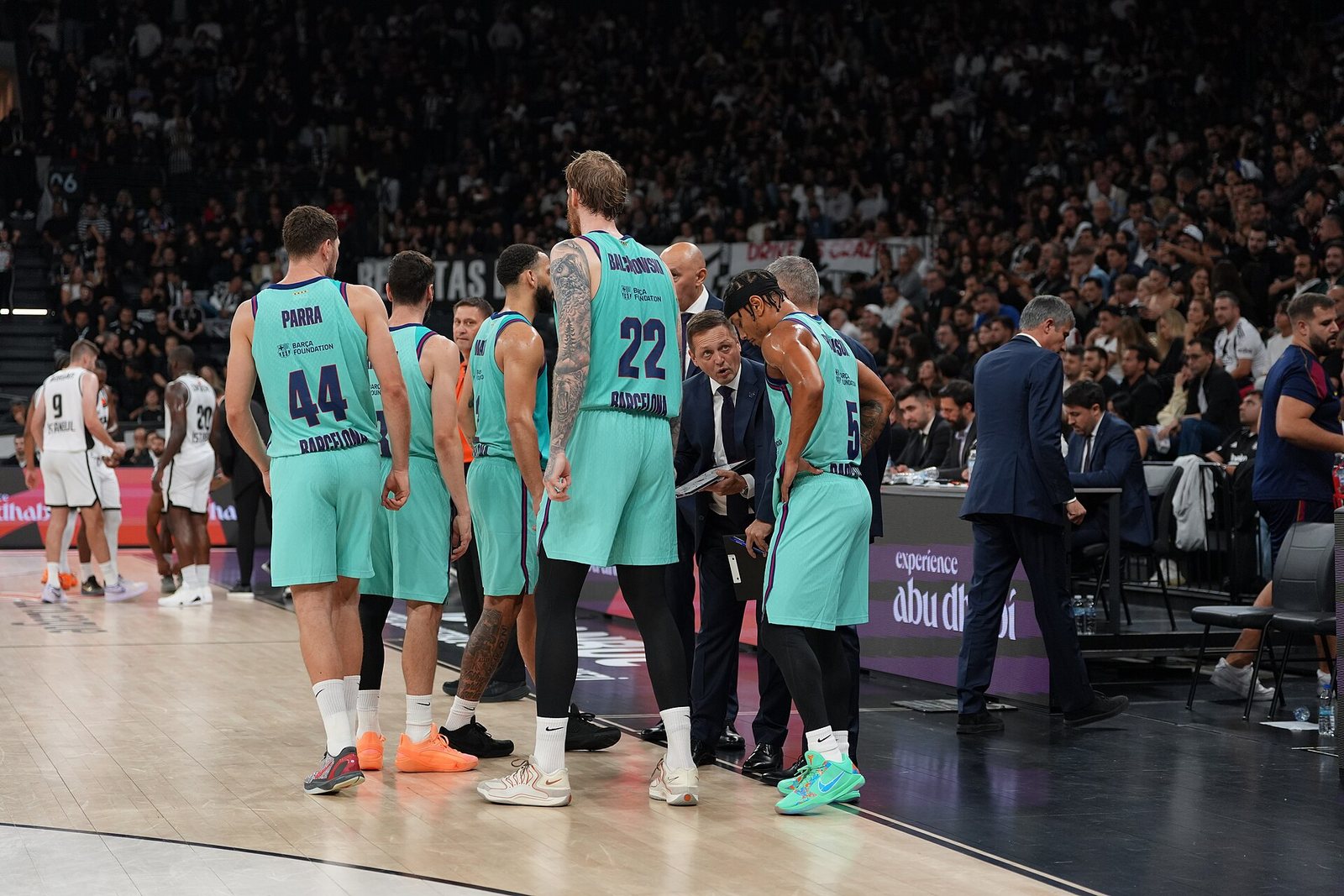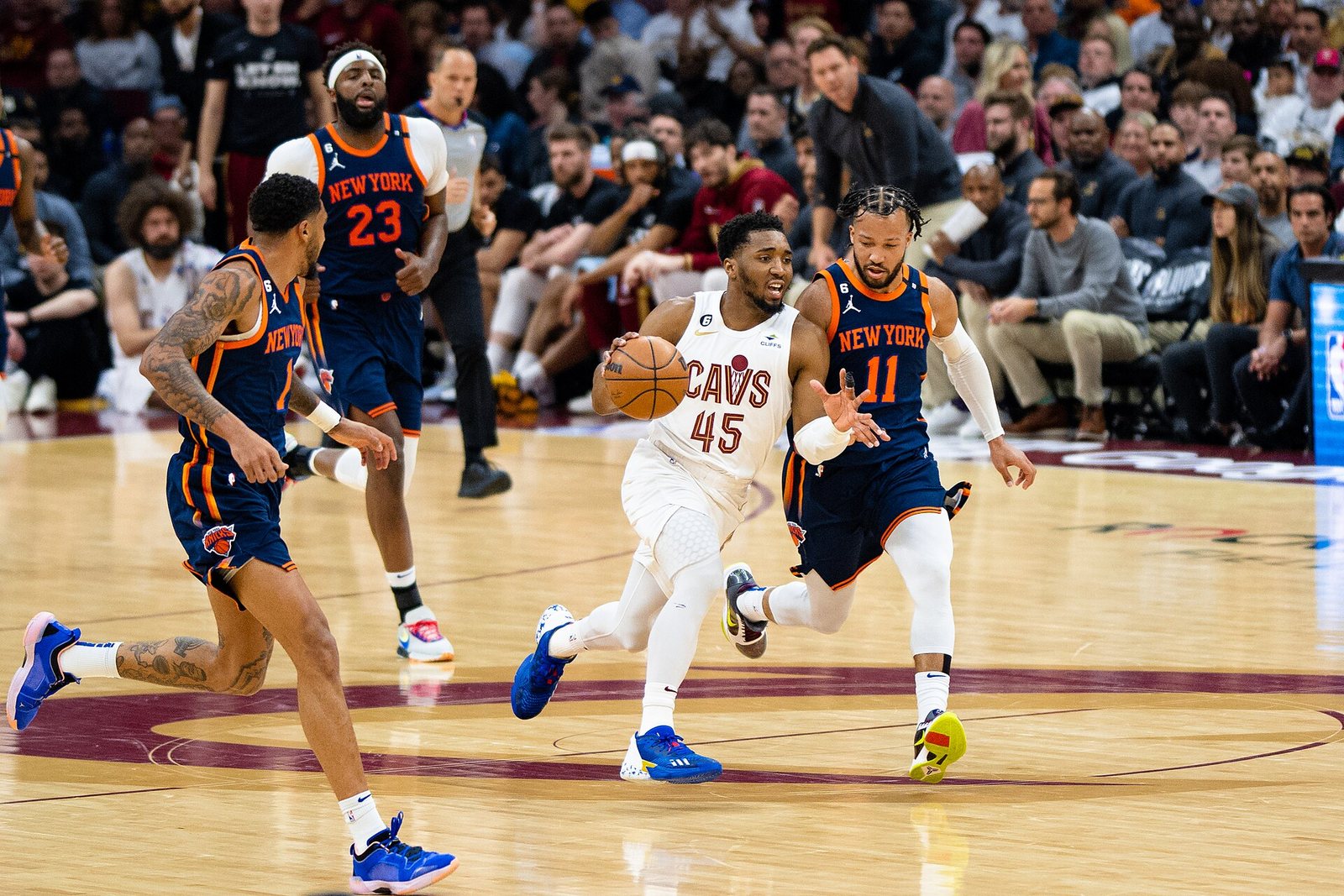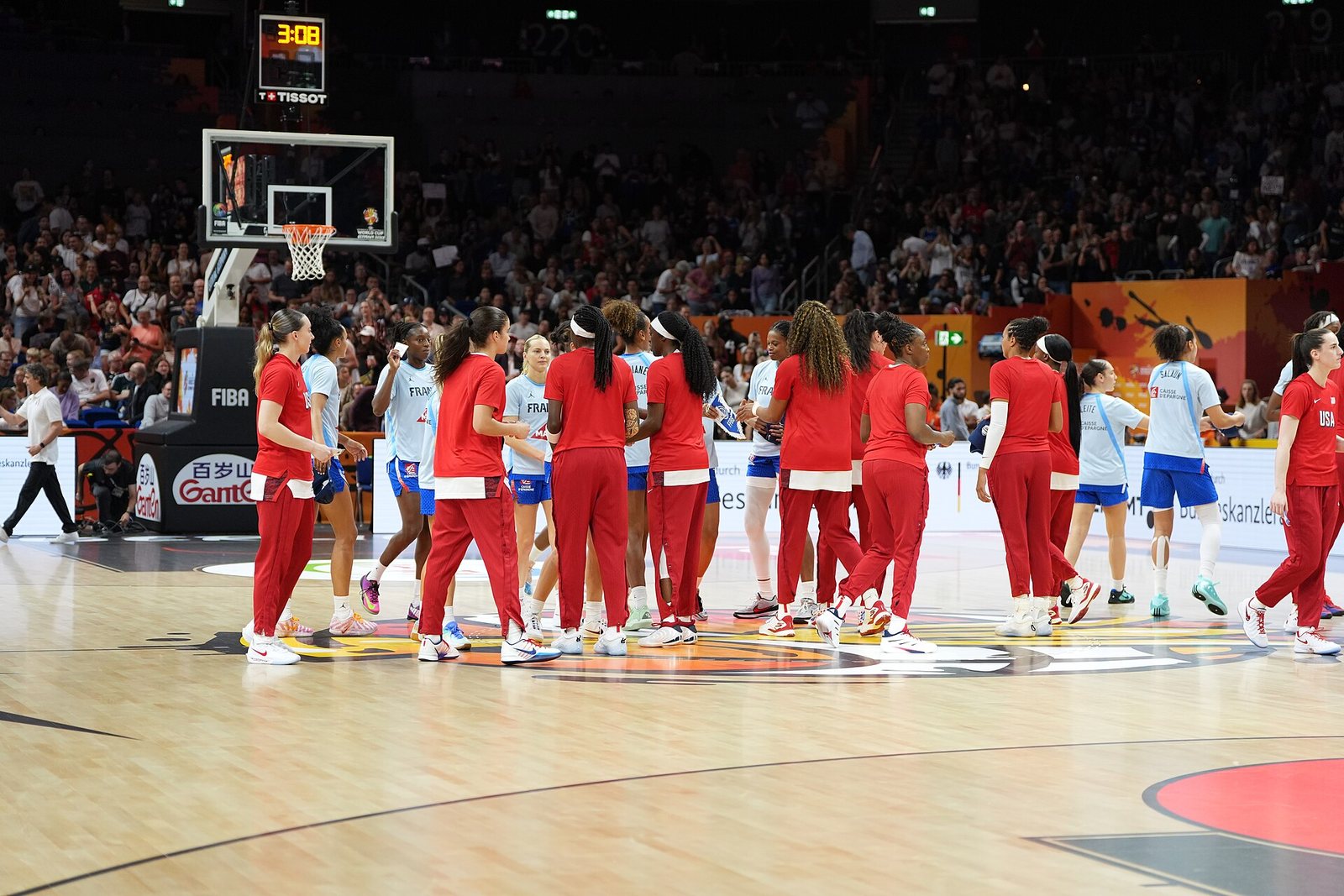
Basketball rules exist in two main editions. The first is set by the International Basketball Federation (FIBA): world championships, the Olympics and most national and club tournaments outside North America are played under it. The second is the NBA’s own rulebook. The differences are not cosmetic: they change the length of a game, the way teams set up on defence and even how centres fight for the ball at the rim. The topic is especially live right now: on 1 October 2026 a new edition of the FIBA rules came into force, and on 20 October the new NBA season tipped off.
Basketball rules in brief: what FIBA and the NBA have in common
The foundation of both rulebooks is the same. Each team has five players on the court, and under FIBA rules no more than 12 players may be entered on the game roster. A made free throw is worth one point, a shot from inside the arc two, and a shot from beyond the three-point line three.
The ball is advanced by bouncing it off the floor; carrying it with a hand underneath is not allowed. Once you have ended your dribble by taking the ball in both hands, you cannot start dribbling again. With the ball in your hands you may take two steps to stop, pass or shoot, while an extra step or lifting the pivot foot before the start of a dribble is a travelling violation. A team has 24 seconds to attack and must move the ball into the frontcourt within eight. If a shot hits the rim and the attacking team rebounds it, the shot clock in both rulebooks resets not to 24 but to 14 seconds. These norms are almost identical in the FIBA and NBA rules, so what follows is where they diverge.
How long is a basketball game?
How many quarters in basketball and how long is an NBA quarter
Both FIBA and the NBA play four quarters. The difference is their length: under FIBA rules a quarter lasts 10 minutes, in the NBA 12. That gives FIBA 40 minutes of playing time and the NBA 48. Overtime is the same, five minutes, and the half-time break also matches at 15 minutes. The short breaks between quarters differ: in FIBA they are two minutes, in the NBA two and a half, and in nationally televised games three and a half between the first and second and between the third and fourth quarters.
So the answer to how long an NBA game lasts is 48 minutes of playing time plus five-minute overtimes if the score is level after the fourth quarter. The eight-minute difference explains why NBA players’ statistics look more impressive: they simply have more time on the court.
Court dimensions and the three-point line
A FIBA court is 28 by 15 metres. In the NBA the floor is slightly bigger: 94 feet long, about 28.65 m, and 50 feet, about 15.24 m, wide.
The difference in the three-point line is more noticeable. In FIBA it is an arc with a radius of 6.75 m from the point directly below the centre of the basket, and near the sidelines it turns into straight segments 0.90 m from the edge of the court. In the NBA the arc is farther out — 23 feet 9 inches, roughly 7.24 m — while in the corners the shot is taken from 22 feet, about 6.71 m. For a shooter moving from Europe to the NBA, that is almost an extra half-metre on the arc, even though the corner shot there is, conversely, slightly closer to the basket than the FIBA arc.
How many fouls a player can commit in basketball before being disqualified
In FIBA a player leaves the court after a fifth foul (Article 41 of the rules). In the NBA it is after a sixth personal foul (Rule 3). The extra foul gives defenders freedom: in the NBA a centre can afford to play more physically without fearing a seat on the bench by the middle of the third quarter.
Team fouls
Both systems penalise a team after four team fouls in a quarter, but the details differ. In FIBA every subsequent personal foul on a player who was not shooting is punished with two free throws, and overtime fouls count towards the fourth quarter. In the NBA the limit is counted for each period, in overtime it is three fouls, and there is also the last-two-minutes rule: if a team has not reached four fouls by then, one foul in the closing stages goes unpunished by free throws.
Basketball rules and fouls: what kinds of fouls exist
In the 2026 FIBA rules, fouls are divided into personal, double, technical, disruptive, flagrant and disqualifying, with fighting covered in a separate article. A personal foul is ordinary illegal contact with an opponent. A technical foul is most often given for behaviour: arguing with officials, provocation, simulation, delaying the game, hanging on the rim. A disqualifying foul is the most serious offence, after which the player goes straight to the locker room.
The NBA has its own scale for hard fouls: a flagrant foul, penalty 1, for a repeat of which in the same game a player is ejected, and penalty 2 — with immediate ejection and a fine.
Time-outs
FIBA gives each team two time-outs in the first half and three in the second, and in the last two minutes of the fourth quarter no more than two may be taken. In each overtime — one. Unused breaks are lost and do not carry over to the next half. Each time-out lasts one minute.
In the NBA a team has seven time-outs per game, but no more than four in the fourth quarter and no more than two in its closing stages, after the three-minute mark. In overtime — two each. In addition, each period includes two mandatory time-outs, while a regular team time-out lasts 1:15, a quarter of a minute longer than in FIBA.
3 second rule basketball defence and zone defence
This is perhaps the main tactical difference. In FIBA only the offensive three-second rule applies: a player of the attacking team may not remain in the opponents’ restricted area for more than three consecutive seconds. A defender, meanwhile, can stand under the basket for as long as he likes, which is why zone defence looks natural in Europe: the centre simply ‘seals off’ the paint.
In the NBA there is also a defensive three-second rule: a defensive player in the three-second area must actively guard an opponent within three seconds, that is, be within arm’s length of him. The violation is punished with a technical foul, and the attacking team keeps the ball. You can play zone in the NBA, but the centre cannot simply stand under the rim.
This rule should not be confused with the ‘three seconds’ of history. That is the name given to the ending of the 1972 Olympic final in Munich, where the USSR national team, after a long pass from Ivan Edeshko and a shot by Alexander Belov, beat the USA 51-50. That episode has nothing to do with the three-second area.
Five seconds
The five-second rule also differs. In FIBA a closely guarded player, when an opponent is no more than a metre away, must pass, shoot or start a dribble within five seconds. In the NBA there is no similar restriction for a player holding the ball, but a player may not dribble with his back or side to the basket below the free-throw line for more than five seconds. The rules on eight seconds to cross into the frontcourt and 24 seconds to attack are the same.
Goaltending
In FIBA goaltending prohibits touching a ball that is on its downward flight to the basket above the level of the rim or has already touched the backboard. But these restrictions apply only until the ball touches the rim. After that, players may play the ball provided they do not touch the basket or backboard while the ball is on the rim and do not interfere with a ball that is already inside the basket.
The NBA is stricter: the ball in an imaginary cylinder above the rim may not be touched at all. That is why fighting for a ball bouncing on the rim, which is legal under FIBA rules, is a violation in the NBA.
The new FIBA rules 2026 and what is changing in the NBA
What changed in FIBA from 1 October 2026
The main news of the new edition is that the FIBA rules no longer contain the unsportsmanlike foul. Instead, two have appeared. A disruptive foul — for example, stopping a fast break, a foul from behind on a player running alone at the basket, or killing time at the end of a quarter without attempting to play the ball. A flagrant foul — for dangerous or clearly non-basketball contact. A flagrant foul counts towards disqualification, a disruptive one does not; both give free throws and a throw-in from the sideline in the frontcourt.
Technical fouls are also divided into two categories, and only the first leads to ejection. Two first-category technicals, two flagrants, or one of each — and the player is disqualified. In addition, FIBA clarified the definition of a player in the act of shooting and expanded video review: goaltending that occurs after a foul can now be reviewed at any point in the game, and in the last two minutes of the fourth quarter and overtime — to check whether the ball was still in the hands of the thrower-in when the defence committed a foul.
NBA rules in the 2026/27 season
The NBA rulebook was not seriously rewritten for the new season: the league announced points of emphasis for officials. For simulation (a flop) spotted during play, a technical foul and a free throw for the opponent are given; if the officials missed the incident, the league can review it after the game — from a warning and escalating fines to a one-game suspension. Also under scrutiny are pushes with the off arm, when an attacker shoves a defender away, two-handed screens, contact on a straight drive to the basket and delaying free throws so that a coach has time to decide whether to use a challenge.
Video review and the coach’s challenge
Both systems give a coach the right to challenge an official’s decision. In FIBA a challenge is available in games with a video review system, and there is one per game regardless of whether it is successful or not.
In the NBA a team also has one challenge, but if it is successful it gets a second. A time-out must be taken to make the call; if it fails, the team loses it. A team may challenge a personal foul called on it, an out-of-bounds call after which the ball was given to the opponent, and goaltending, except in the last two minutes of the fourth quarter and overtime.
NBA vs FIBA rules: the main differences in short
- Time: FIBA — 4 quarters of 10 minutes, NBA — 4 of 12.
- Three-point line: 6.75 m against 7.24 m.
- Foul limit: five in FIBA, six in the NBA.
- Time-outs: 2+3 and one each in overtime in FIBA, seven per game in the NBA.
- Defensive three seconds exist only in the NBA.
- After touching the rim the ball can be played in FIBA, but not in the NBA.
- The unsportsmanlike foul no longer exists in FIBA: it has been replaced by the disruptive and flagrant fouls.
If you want to see the FIBA rules in action at club level, start with the EuroLeague: its games are played on weeknights, and the season is already in full swing.
Frequently asked questions about basketball rules
How long is a basketball game?
Under FIBA rules — 40 minutes of playing time, under NBA rules — 48. If the score is level, five-minute overtimes are added.
How many quarters in basketball and how many minutes each?
There are always four quarters. In FIBA each lasts 10 minutes, in the NBA — 12.
How many fouls in basketball before you’re out?
In FIBA a player leaves the court after a fifth foul, in the NBA — after a sixth. Separate ejections apply for two flagrant fouls or two first-category technical fouls (FIBA) and for a flagrant foul, penalty 2 (NBA).
How many metres to the three-point line?
In FIBA the arc runs 6.75 m from the point directly below the centre of the basket. In the NBA — roughly 7.24 m, and in the corners about 6.71 m.
What is the 3 second rule in basketball?
An attacking player may not stand in the opponents’ restricted area for more than three consecutive seconds — this rule exists in both FIBA and the NBA. The NBA adds defensive three seconds: a defender in the area must guard an opponent, otherwise the team is given a technical foul.