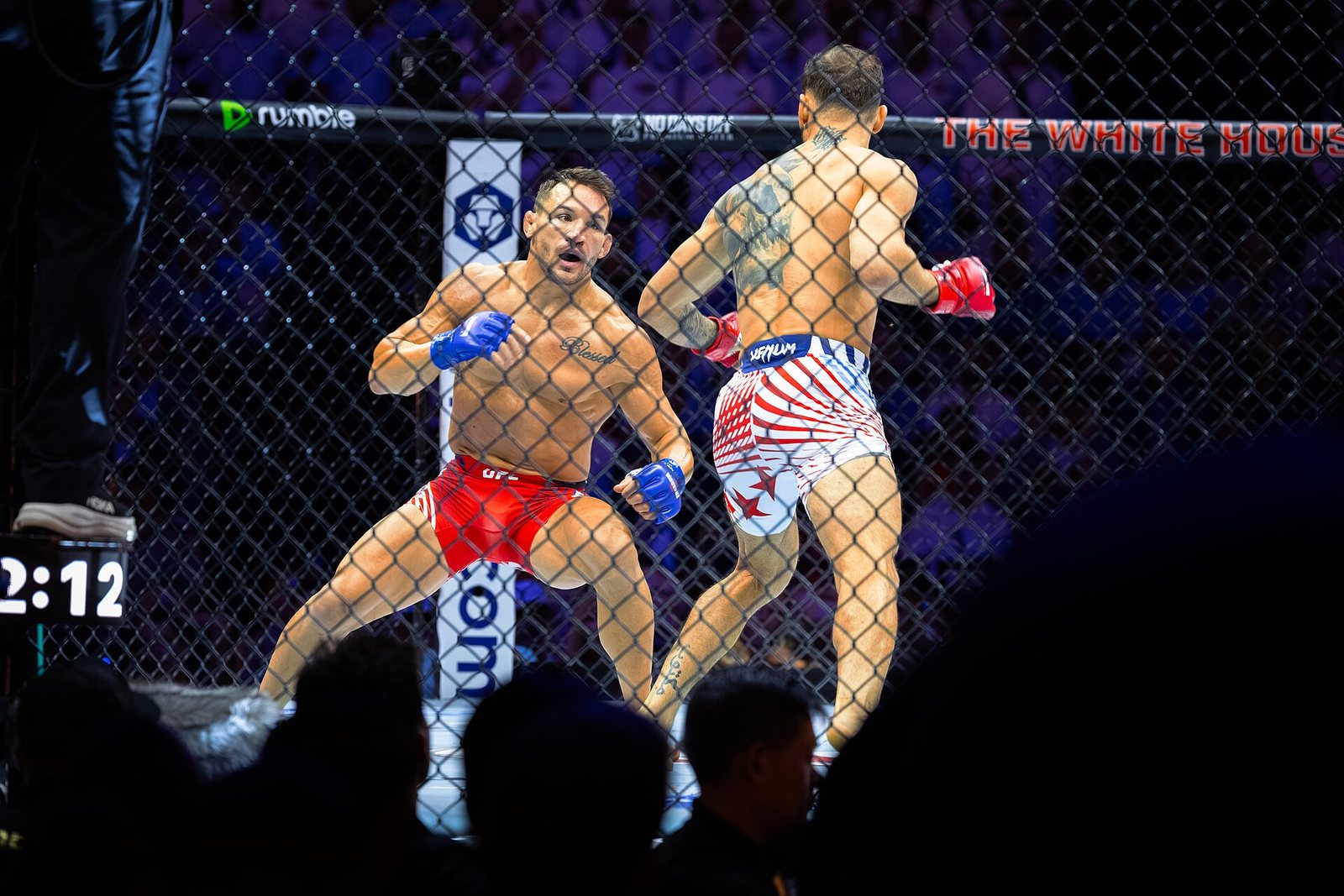
How MMA is scored when a fight ends early is clear to any viewer: the opponent tapped, fell, or the referee stepped between the fighters. It is harder when the final bell sounds. Then three people at the cage decide the outcome, and their scorecards regularly spark debate. To understand why the judges saw the fight differently from you, you need to know the MMA judging criteria they work by.
MMA rules: where the Unified Rules came from
Which rules apply in MMA at a particular event depends on who sanctions it. Most professional events in the United States and many beyond are held under the Unified Rules of Mixed Martial Arts. They are maintained by the Association of Boxing Commissions (ABC), and applied by individual athletic commissions — state or national. The MMA rules in the UFC are those same Unified Rules: the league has worked under them since November 2000. An important caveat: the rules are ‘unified’ only in a loose sense. Each commission decides for itself whether to adopt the latest amendments, so details can differ between jurisdictions.
How many rounds in the UFC and the weight classes
A regular UFC fight lasts three rounds of five minutes; title fights and main events of the night are five rounds. There is one minute of rest between rounds. A fight cannot last more than five rounds and 25 minutes.
There are eight men’s weight classes in the UFC, with limits given in pounds:
- flyweight — 125 (56.7 kg);
- bantamweight — 135 (61.2 kg);
- featherweight — 145 (65.8 kg);
- lightweight — 155 (70.3 kg);
- welterweight — 170 (77.1 kg);
- middleweight — 185 (83.9 kg);
- light heavyweight — 205 (93 kg);
- heavyweight — 265 (120.2 kg).
In the women’s divisions, the lightest class is strawweight with a limit of up to 115 pounds, followed by flyweight and bantamweight with the same limits as the men. The official weigh-in takes place the day before the fight, between 9 and 11 a.m. local time. In a non-title fight a fighter is allowed to exceed the limit by one pound; in a title fight they are not. Anyone who misses weight risks forfeiting part of their purse to their opponent, and the fight may be moved to a catchweight or cancelled.
How points are scored in MMA: the 10-point system
MMA judging is built on the 10-Point Must System. Each of the three judges scores each round separately. The winner of a round must receive 10 points, and the loser 9 or fewer. After the fight the round scores are added up. Penalty points are not deducted by the judges but by the scorekeeper, and only at the referee’s decision: if the referee has not called a foul, the judges are not entitled to take it into account themselves.
MMA judging criteria: three criteria in order
In the ABC rules the criteria are set out in strict order of priority:
- Effective striking and grappling. Legal strikes, takedowns, submission attempts, sweeps and advantageous positions that produce immediate or cumulative impact and can bring the fight closer to its end. Immediate impact carries more weight than cumulative impact. A takedown is not valued in itself, but only if an attack follows it. Being on top or bottom is assessed by the result of the action, not by the position.
- Effective aggression. Attempts to finish the fight that produce a result. Chasing an opponent without effect does not count. This criterion applies only if the fighters are completely equal on the first point.
- Fighting area control. Who dictates the pace, the place and the position. It is used only if there is complete equality on both of the first two points — the rules explicitly call this extremely rare.
From this follows a simple thing that viewers often miss: pressure and moving forward without landing anything are worth almost nothing. MMA judges look first at damage and the threat of a finish.
What 10-8 means in the UFC, as well as 10:9, 10:7 and 10:10
- 10:9 — a round won by a narrow margin, by at least one technique. The most common score.
- 10:8 — a round won by a large margin. The rules set three markers: impact, dominance and duration. If a judge sees all three — dominance, its duration and damage that reduced the opponent’s capabilities — they must score it 10:8. If there is only clear dominance or only serious damage, the judge must consider such a score. Dominating for all five minutes is not required for this.
- 10:7 — overwhelming superiority such that stopping the fight would have been justified. Rarely given.
- 10:10 — complete equality. Under the rules such a score should be extremely rare, and a judge is not entitled to hide behind it if they could not make sense of the round.
Another detail from the rules: the loser of a round does not automatically get a nine. If a fighter barely attacked and merely tried to survive, the judge should be thinking about 10:8.
Methods of victory: technical knockout, submission, decision
Commission regulations list similar outcomes. For example, in the New Mexico rules these are knockout, submission, technical knockout, decision, no-show, disqualification and ‘no contest’.
Early finishes
- Submission — a fighter taps with their hand or tells the referee they cannot continue. A cry of pain also counts as a submission.
- Knockout — a fighter loses consciousness from a strike or a series of strikes.
- Technical knockout — the referee stops the fight because the fighter has stopped responding and defending. The fight can also be stopped by the doctor or the fighter’s corner: throwing in the towel is no longer considered a foul under the Unified Rules.
- Disqualification — for a serious foul or a combination of them.
Technical knockout vs knockout: the difference
In a knockout the fighter is ‘switched off’ and physically cannot continue. In a technical knockout they may be conscious, but the fight is stopped for them: the referee sees that there is no defence left, the doctor does not allow them to continue because of a cut or injury, or the corner throws in the towel. A technical knockout should not be confused with a technical decision: a technical decision is awarded on the judges’ scorecards when a fight is stopped because of an accidental foul.
On the scorecards: unanimous, split and majority decision
- Unanimous decision — all three judges gave the fight to one fighter. That is how, on 15 August 2026 at UFC 330, Islam Makhachev beat Ian Machado Garry: 49:46, 49:46, 48:47 (more in the Makhachev profile).
- Split decision — two for one fighter, the third for the other.
- Majority decision — two for one fighter, and the third scores a draw.
- Draw — if there is no winner on the scorecards. It too can be unanimous, majority or split.
- Technical decision — if the fight is stopped because of an injury from an accidental foul, once a sufficient portion of the fight has passed; the winner is determined on the scorecards. If it happens too early, the fight is declared a no contest. The threshold in rounds is set by the commission.
The difference between a split decision and a majority decision is easiest to grasp from the third scorecard. In a split decision one judge gave the fight to the winner’s opponent; in a majority decision they saw a draw. In both cases two votes are enough for the winner. The same terms work in boxing too: in 2024 Oleksandr Usyk beat Tyson Fury by split decision — see the article on boxing belts.
Fouls in MMA and the new UFC rules
The list of prohibited actions includes headbutts, eye pokes and finger pressure to the eyes, biting, hair pulling, strikes to the groin, back of the head, spine and throat, grabbing the cage with the fingers, twisting small joints (fingers of the hands and feet), knee and kick strikes to the head of a grounded opponent, and stomping a grounded opponent. It is also prohibited to extend an open palm with outstretched fingers towards an opponent’s face. After a low blow or an eye poke a fighter gets up to five minutes to recover.
In the summer of 2024 the ABC adopted two amendments that took effect on 1 November of that year. First, the ‘12–6’ elbow was legalised — a strike straight down from above, banned since the earliest editions of the Unified Rules. It was for such strikes that Jon Jones was disqualified in 2009 in his fight with Matt Hamill. Second, the definition of a grounded fighter was changed: a fighter is now considered grounded if they touch the canvas with any part of the body other than the hands and feet. Previously a palm on the mat was enough — you only had to touch the canvas with a hand for a knee to the head to become a foul. The amendments, like everything in the Unified Rules, are adopted by each commission separately.
On 5 August 2026 the ABC approved another package of changes to the Unified Rules. Commissions have been invited to introduce them from November 2027.
Why MMA judging still causes disputes
MMA judges sit on their own side of the cage and see the fight from their own angle, while ‘effectiveness’ and ‘damage’ are concepts that cannot be measured with a stopwatch. The strike statistics shown on broadcasts count the strikes that land, but not their power. That is why a round in which one fighter threw more strikes and the other landed one heavy shot can, under the rules, quite legitimately go to the second. Knowing how MMA is scored and in what order the criteria come makes such decisions easier to understand — even if you disagree with them.
Frequently asked questions about how MMA is scored
How does MMA judging work?
Three judges score each round under the 10-point system: the winner of a round gets 10, the loser 9 or fewer. The main criterion is effective striking and grappling, then effective aggression and fighting area control.
What does 10-8 mean in the UFC?
A score of 10:8 in MMA is given for a round won by a large margin: one fighter inflicted serious damage, dominated, and did so for a noticeable part of the round. If a judge sees all three markers, they must score it 10:8.
What is the difference between a majority decision and a split decision?
In a split decision two judges give the fight to one fighter and the third to the other. In a majority decision two are for one fighter and the third scores a draw.
What is the difference between a technical knockout and a knockout?
A knockout is a loss of consciousness from a strike. A technical knockout is the stopping of a fight by the referee, doctor or corner when a fighter can no longer defend themselves or continue, even if they are conscious.
How many rounds are there in the UFC?
A regular fight is three rounds of five minutes; title fights and main events of the night are five rounds. There is one minute of rest between rounds.
What are the fouls in the UFC?
Headbutts, eye pokes, biting, strikes to the groin, back of the head, spine and throat, knee and kick strikes to the head of a grounded opponent, and stomping a grounded opponent. The ‘12–6’ elbow has been legal since November 2024.